Ask a dealership finance office to "get the payment down" and the usual answer is a longer loan. More buyers are saying yes. In the third quarter of 2026, a record 25.5% of financed new-vehicle purchases had terms of 84 months or longer, up from 21.8% a year earlier, according to Edmunds. Used-car buyers are stretching too. A seven-year loan can lower the payment, but you pay for it in total interest and in years of owing more than the car is worth.

- Edmunds Q3 2026: 25.5% of new-car loans ran 84+ months, 21.2% of new-car buyers and 6.5% of used-car buyers took on $1,000+ payments. All three are records.
- On an average used-car loan ($30,703 at 10.6%), going from 48 to 84 months cuts the payment by about $269 but adds about $5,800 in interest.
- If the only way to afford the car is 84 months, the car is probably too expensive. Look at a cheaper car, a fairer price, or a bigger down payment before you stretch the term.
01The records
Edmunds' Q3 2026 release lists several records. The average new-vehicle amount financed reached $44,664. The average new-car payment was $787. Total interest over the life of the average new-car loan hit $9,938, even though the average APR held at 7.0%. Edmunds says that's because buyers are financing larger amounts over longer terms. Among new-car buyers with payments of $1,000 or more, 69% chose terms of 72 months or longer.
Used-car loans are long too. The average used-car term in Q3 was 70.4 months, with $30,703 financed at 10.6% APR and a $582 average payment. Edmunds' director of insights, Ivan Drury, put it this way: "Stretching out a loan shouldn't be a way to talk yourself into a vehicle that doesn't make sense for your budget when you look at the total cost."
02What stretching actually costs
Here's Edmunds' average used-car loan at four different terms:
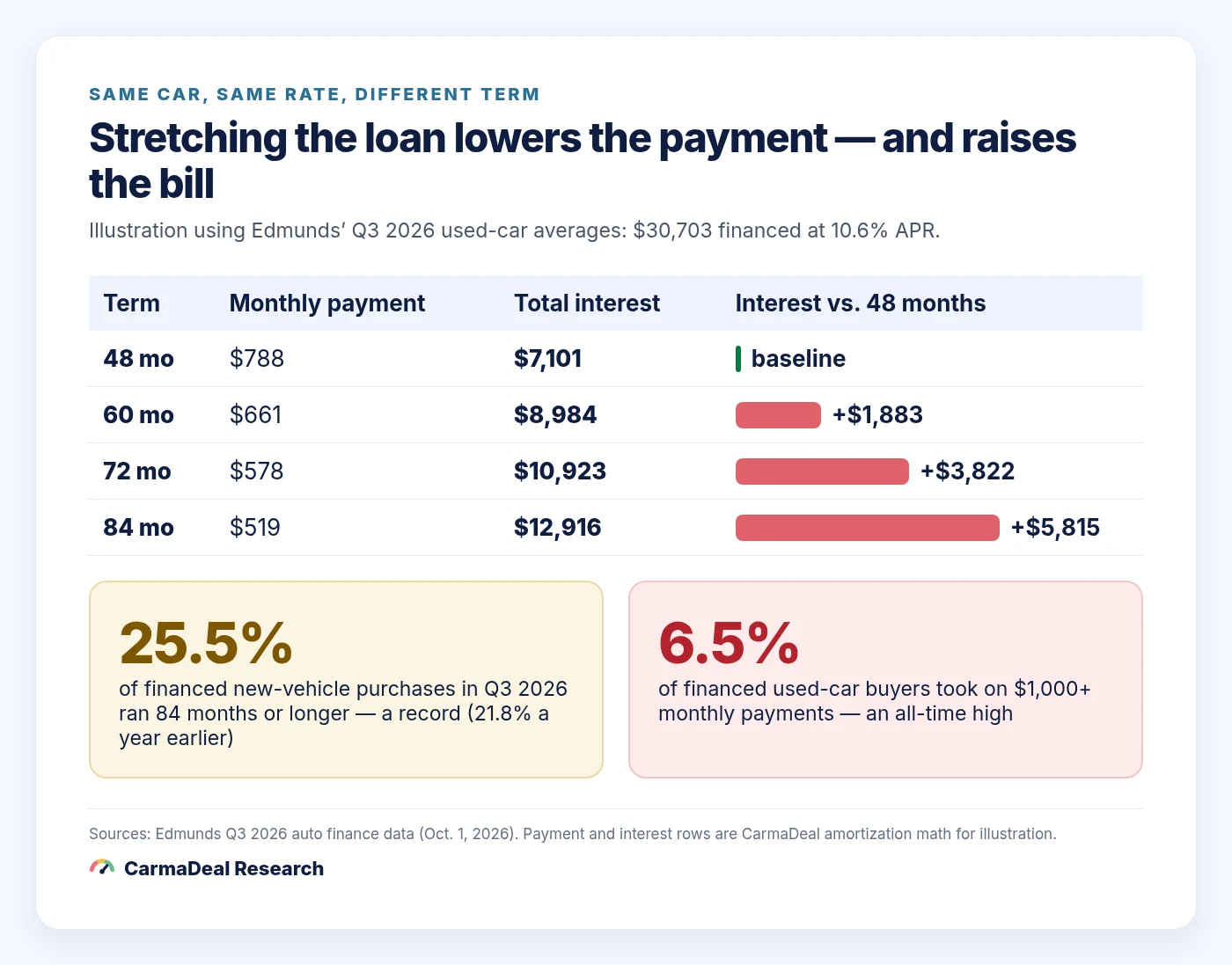
Going from 48 to 84 months lowers the payment from about $788 to about $519, and raises total interest from about $7,100 to about $12,900. That assumes the same APR, which is generous. Experian notes that shorter terms can come with lower rates, so the real difference is often bigger.
03The bigger risk: negative equity
Interest isn't the only cost. On a long loan, the balance falls slowly in the early years while the car loses value quickly. That leaves many buyers "underwater," owing more than the car is worth, for a large part of the loan. This is a bad time to be underwater: Cox Automotive says wholesale used values weakened this fall, with three-year-old vehicles down about 6% in the third quarter, roughly twice the normal decline (Cox Q3 2026 presentation).
Being underwater becomes a real problem when life changes: a job move, a growing family, a crash that totals the car. If you need to sell or trade, you have to pay off the gap or roll it into the next loan, which makes the next car more expensive. Our negative-equity guide covers what to do if you're already there.

04Better ways to lower the payment
- Pay a fair price. Every dollar you negotiate off is a dollar you don't finance at 10%+. At 10.6% over 72 months, $1,500 off the price lowers the payment by about $28 and saves about $530 in interest, with no extra years added.
- Look one tier down. A slightly older model year, a lower trim, or a more common model in the same class can cut thousands from the price. Our reliable used cars under $20K list is a good place to start.
- Shop the rate. Moving from near-prime to prime pricing, or from a dealer markup to a credit-union rate, can save more than a longer term. See how to shop a used-car loan after the Fed's hike.
- Turn down add-ons financed over 84 months. A $2,500 service contract rolled into a seven-year loan at 10.6% costs you about $3,550 by the time it's paid off.
- Put more down. Edmunds shows average down payments on both new and used cars fell from a year earlier. Moving the other way builds equity faster.

05Four lines to check on the contract
Finance offices talk about the monthly payment. The retail installment contract shows the full cost. Before you sign, find these four lines and make sure they match what you agreed to:
- Amount financed: the agreed price, minus your down payment and trade-in, plus tax and fees. Nothing else should be in it unless you chose it.
- APR: the rate you were quoted, not a slightly higher one.
- Term: the number of months you agreed to.
- Finance charge and total of payments: the dollar cost of borrowing. If the finance charge is about half of what you borrowed, the term is probably too long.
06A simple rule
Before you visit the dealer, decide on two numbers: the most you'll pay out the door and the longest term you'll accept. Then stick to them. If the car only works at 84 months, it's the wrong car or the wrong price.
CarmaDeal helps with the first number. Enter the 17-character VIN and the advertised price to get a Deal Score from live local comparables and an itemized out-the-door estimate. If the car scores poorly, you'll know before the finance office starts working on the payment.
Sources and verification notes
- Edmunds, New-Car Financing Records Pile Up in Q3, Oct. 1, 2026 (all Edmunds figures and the Drury quote).
- Experian, Used Car Loan Interest Rates 2026 (shorter terms can carry lower rates).
- Cox Automotive, Q3 2026 MUVVI presentation transcript (three-year-old value decline).
- Payment, interest, and add-on cost examples are CarmaDeal amortization calculations at a constant APR.