You find a used SUV online at $27,995. You drive 40 minutes, take a test drive, sit down, and the buyer's order says $29,840 before tax. The extra money comes from a doc fee, a "reconditioning" charge, and a protection package that was "already on the car." On September 15, 2026, the Federal Trade Commission's staff said, about as plainly as a regulator can, that this shouldn't happen.

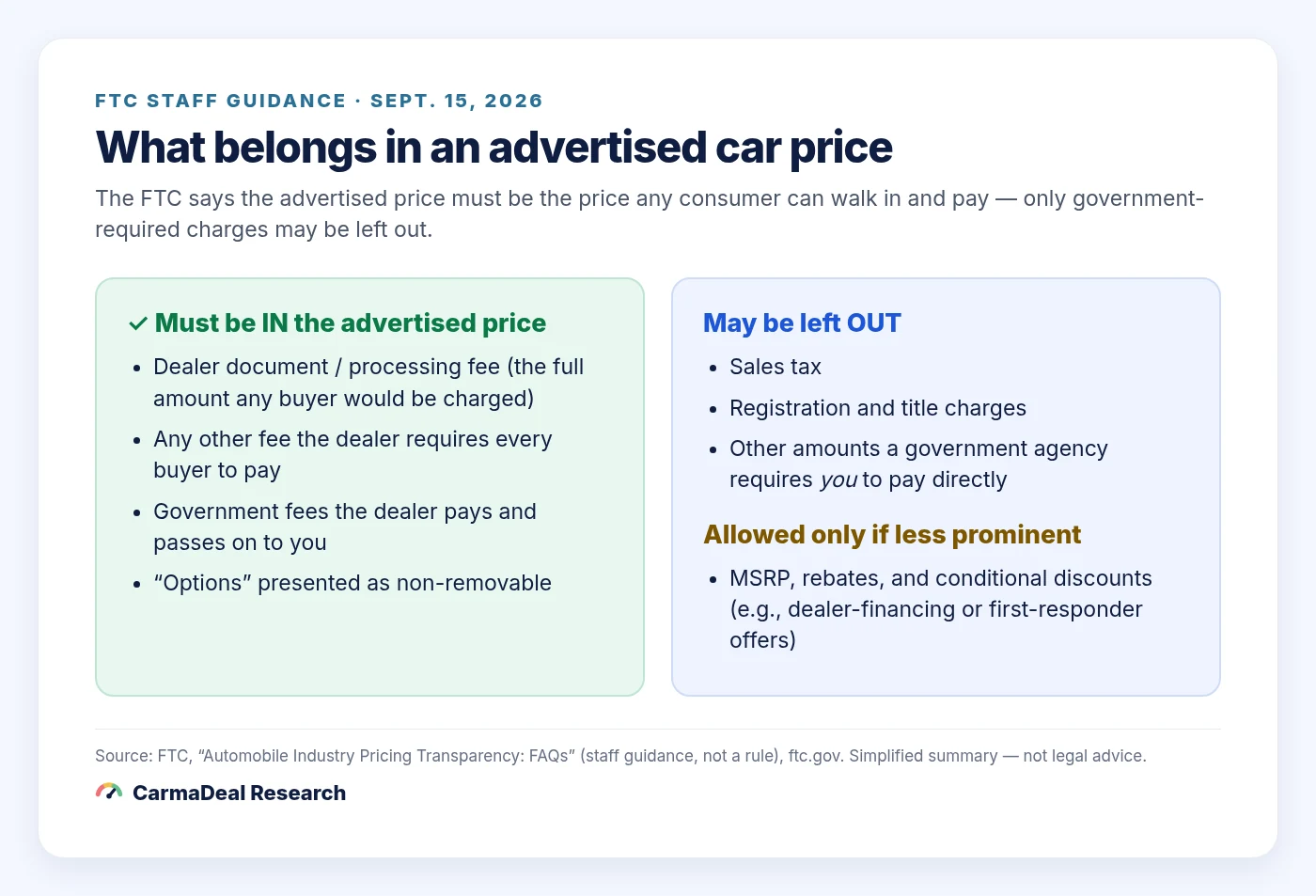
- FTC staff guidance says an advertised vehicle price must be the actual price any consumer can walk in and pay. Only charges a government requires you to pay (tax, title, registration) can be left out.
- That includes the full doc fee and any other fee the dealer charges every buyer. It covers websites, listing pages, social posts, phone calls, and texts.
- It's staff guidance, not a new rule. It won't force a lower price, but it gives you a clear, citable standard: advertised price + government charges = your starting out-the-door number.
01What the FTC actually said
The FTC published "Automobile Industry Pricing Transparency: FAQs" along with a press release stating that "the advertised price of a vehicle must be the actual price that any consumer can walk in and pay to purchase the vehicle, excluding only charges that the government requires the consumer to pay." The agency also said it had already sent letters to 97 auto groups earlier in the year warning them about advertised prices.
The FAQs get specific in ways that matter to a buyer:
- Doc fees go in the price. The FTC's own example: if a dealer advertises a $40,000 vehicle and charges every buyer an $85 document fee, the advertised price has to be $40,085. If some buyers are quoted a higher doc fee, the ad has to use the higher one.
- Government pass-throughs go in too. Fees the government makes the dealer pay, which the dealer then passes on to you, belong in the advertised price. Only amounts the government requires the consumer to pay directly can be left out.
- The real price must be the most prominent number. On any web page that shows an amount, including search results and individual listing pages, the actual price has to be the most prominent figure. MSRP and conditional discounts can appear, but they can't steal the spotlight.
- No "discount for some people" headline prices. A dealer can't advertise a price built around a rebate or dealer-financing discount that only some buyers qualify for, unless the price everyone can pay is the most prominent one.
- Add-ons can't be passed off as mandatory. Dealers can't suggest an optional product is required, or say an installed "option" can't be removed and must be paid for.
- Phone and text quotes count. The FAQs say these principles apply to phone calls and text messages with dealership staff, not just ads.
02What it doesn't do
Be realistic about the limits. The FAQs say they "represent the views of FTC staff" and are "not binding on the public or the Commission." Whether a particular ad is deceptive still depends on its facts. The guidance is not the old FTC CARS Rule, and it doesn't cap doc fees, ban add-ons, or set prices. Your state's rules on doc fees and disclosures still apply on top of it.
It also doesn't promise that a dealer's price is fair. A fully transparent $27,995 can still be $1,500 above what comparable cars sell for in your area. Transparent pricing tells you what the number is. You still need to figure out whether it's a good number.
03How to use it before you visit
The best time to use this guidance is before you drive anywhere. Three steps:
- Save the listing. Write down the advertised price, the date, and the listing page it came from. If the price changes later, you have a record.
- Ask for an out-the-door quote in writing. Email or text: "Can you confirm the out-the-door price for VIN [17 characters], including all dealer fees, with only tax, title, and registration added?" A written answer is easier to compare, and under the FTC's view, a texted quote should already be all-in.
- Do the math yourself. Take the advertised price and add only your state's tax, title, and registration. That's your benchmark. Any extra line on the buyer's order that every customer pays is a question to ask.

04What to say when the numbers don't match
When the buyer's order comes in higher than the ad, stay calm and point to the gap:
"Your listing showed $27,995. With tax, title, and registration I expected about [your number]. Can you show me which of these extra charges are optional, and take those off?"
That wording doesn't accuse anyone of breaking the law. It just asks the dealer to separate required government charges from everything else. Most add-ons, like etching, nitrogen tire fills, paint protection, and service contracts, are optional, and you can decline them. Our guide to the $3,000 dealer fee stack breaks down the usual ones, and our F&I add-on guide explains how to say no to them without losing the car.
If a fee really is charged to every buyer, the FTC's view is that it should have been in the advertised price. That gives you a fair negotiating position: ask the dealer to honor the advertised number as the pre-tax price. Some will. If they won't, you've learned something about how they do business before you've signed anything.
If you believe an ad was misleading, the FTC asks consumers to report it at ReportFraud.ftc.gov and to note any documentation, such as screenshots of ads or copies of contracts.

05Transparent is not the same as fair
Once you know the real all-in number, the next question is whether that number is any good. Look at three things:
- Price against comparable cars: where the vehicle price sits compared with similar listings nearby (same year, trim, mileage band, and drivetrain).
- The out-the-door total: what you'll actually pay after legitimate tax and fees for your ZIP code.
- The car's own history: title brands, open recalls, and anything that makes a "good price" too good.
CarmaDeal handles the price side from the VIN. Enter the 17-character VIN and the advertised price, and the report shows a Deal Score from live local comparables along with an itemized out-the-door estimate (tax for your ZIP, doc and registration fees). Every line can be edited, so you can match it to the dealer's paperwork line by line. The Deal Score doesn't check title brands or accident history on its own, so run the car's CARFAX or AutoCheck report through our History Report Analyzer as a separate step.
Sources and verification notes
- Federal Trade Commission, Automobile Industry Pricing Transparency: FAQs (staff guidance; not binding on the public or the Commission).
- Federal Trade Commission, FTC Publishes Price Transparency FAQs for Auto Dealers, Sept. 15, 2026 (quote and 97-auto-group letters).
- CarmaDeal, The Anatomy of a $3,000 Dealer Fee Stack.
- The $27,995 listing in the introduction is an illustrative scenario, not a real transaction. This article is general information, not legal advice. State doc-fee and disclosure rules vary.