Most car buyers in America have no "cooling-off" period. Once you sign, the car is yours. Since October 1, 2026, that changed for California dealer purchases. The state's Combating Auto Retail Scams (CARS) Act, passed as SB 766, gives most used-car buyers three days to change their minds. It also requires a real total price up front and limits the add-ons a dealer can charge for. Here's what you get, what it costs to use, and where it stops.

- Licensed California dealers must now give a free 3-day right to cancel on used vehicles priced $50,000 or less. A capped restocking fee applies if you use it.
- Dealers must show a total price in ads and in their first written reply about a specific car, must label dealer-installed add-ons as optional, and can't charge for add-ons that give you no benefit.
- It doesn't cover new cars, private-party sales, lease buyouts, or cars driven more than 400 miles after signing. Do your homework before you sign.
01Who's covered
According to the California DMV's implementation memo, the CARS Act applies to licensed California dealers selling or leasing light-duty vehicles under 10,000 pounds at retail. Wholesale, fleet, and auction sales are exempt. The state's Business and Consumer Services Agency calls it "the strongest car-buying protections in the nation" and estimates it will save California buyers at least $234 million a year.
The three-day return right is narrower than the pricing rules. Based on the statute as summarized in the California New Car Dealers Association compliance guide, it covers:
- Used vehicles only, priced at $50,000 or less on the contract (a $50,000 sale is covered, $50,001 is not). New cars aren't covered at any price.
- Not motorcycles, not lease-end buyouts by the person already leasing the car, and not compliant auction sales.
- Not if you've driven it more than 400 miles between signing and trying to cancel.
Private-party sales aren't dealer sales, so they're outside the Act entirely. If you buy from a neighbor, the old rules apply: inspect first, and protect the payment. Our private-party payment guide covers how.
02How the 3-day clock and restocking fee work
The window is three calendar days, starting the day after you sign, and it ends at close of business on day three. If the dealership is closed on day three, the deadline moves to the next day it's open. (The DMV memo describes the window as "three business days"; the CNCDA guide cites the statute's calendar-day definition. Go by the deadline printed on your cancellation disclosure, and ask the dealer to confirm it in writing.) Sign on a Monday, and you have until close of business Thursday.
The right itself is free. Under the old law, buyers had to pay for an optional two-day contract cancellation option; the CARS Act replaces that. If you do cancel, the dealer can keep a restocking fee:
- Base charge: 1.5% of the vehicle's contract sale price, with a $200 minimum and a $600 maximum.
- Mileage charge: $1 per mile over 250 miles driven, up to $150.
- The fee comes out of your refund first. The dealer can't demand cash up front if the refund covers it.
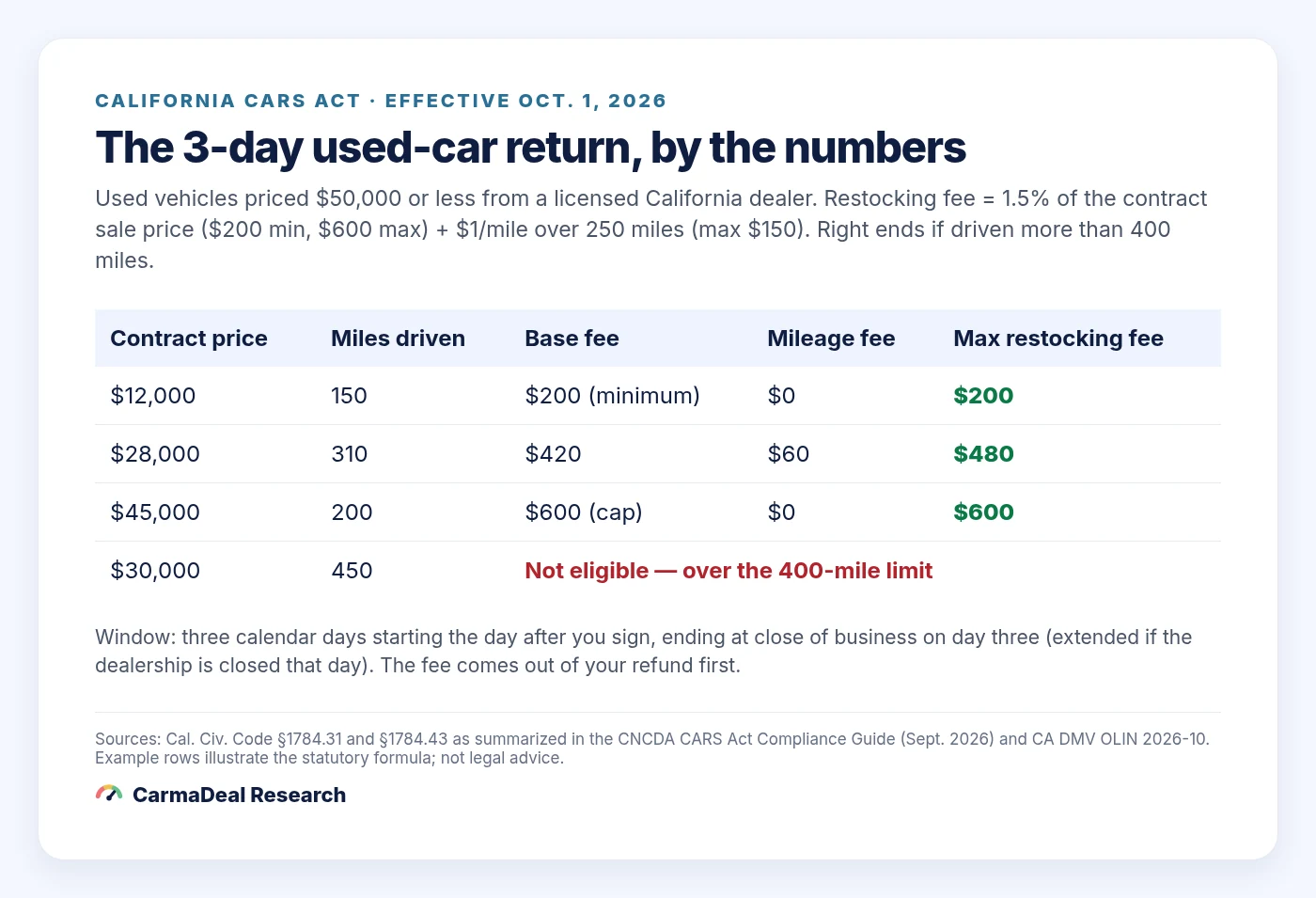
In dollars: on a $28,000 SUV returned after 310 miles, the maximum fee is $420 + $60 = $480. On a $12,000 commuter car, it's the $200 minimum. A dealer can voluntarily offer a longer window or a lower fee, but can't offer less than the law requires.
03The pricing and add-on rules (these apply to new cars too)
The return right gets the headlines, but the pricing rules probably affect more buyers day to day. The DMV memo lists the main ones:
- Total price disclosure in any ad that mentions a specific vehicle or financing terms, and in the dealer's first written communication with you: an email, a text, a quote, or a credit application.
- Add-ons must be labeled optional, both verbally and in writing (in at least 12-point type).
- No "valueless" add-ons. The memo's examples are oil changes for EVs and nitrogen tire fills that don't benefit you. The BCSA also mentions catalytic-converter marking on an EV.
- No misrepresentations about price, availability, financing terms, add-ons, or trade-in payoffs.
- Dealers must keep compliance records for two years, including ads, price communications, and add-on consents. That paper trail helps you if there's a dispute.
National buyers get part of this too. The FTC's September 2026 staff guidance says advertised prices must already include dealer fees everywhere in the U.S. See our explainer on what the FTC said about all-in pricing.
04How to use the 3 days well

Three days goes fast. If you're relying on the window, schedule things before you sign:
- Book an independent inspection for day one or two. A pre-purchase inspection is still better before you sign, but a post-sale inspection inside the window is the next best thing.
- Get a real insurance quote on the VIN. A surprise premium is a legitimate reason to reconsider.
- Keep the miles low. Fees start above 250 miles, and the right ends past 400. A long road trip is the easiest way to lose it.
- Read the cancellation disclosure and confirm the exact deadline printed on it. Keep your copy.
- Check the deal itself. Compare the contract price against the advertised total price and local comparables. If the deal was overpriced, three days is your chance to undo it for a few hundred dollars rather than live with it for years.
05The return right is a backup plan
A return window helps, but it's no substitute for knowing the car and the price before you sign. A $480 restocking fee is much better than a bad loan, and it's still $480 you didn't need to spend. Decide whether the car is worth the money first, and treat the 3 days as backup.
CarmaDeal helps with that decision. Enter the 17-character VIN and the advertised price, and you'll get a Deal Score from live local comparables, an itemized out-the-door estimate for your ZIP, and recall campaigns for that model to look at before you go to the dealership. Confirm whether this exact VIN has an unrepaired recall at NHTSA's recall lookup. Check title and accident history separately with our History Report Analyzer.
Sources and verification notes
- California DMV, OLIN 2026-10: Implementation of CARS Act (SB 766), Sept. 22, 2026.
- California Business and Consumer Services Agency, press release, Oct. 2, 2026 ($234 million estimate; add-on examples).
- California Legislature, SB 766 bill text.
- California New Car Dealers Association, CARS Act Compliance Guide (Sept. 2026), cited for the eligibility, period, and restocking-fee formula (Cal. Civ. Code §§1784.31, 1784.43). This is an industry source written for dealers.
- Restocking-fee examples are CarmaDeal calculations using the statutory formula. This article is general information, not legal advice.