If your budget is $15,000 or less, you're not imagining it: there are fewer cars to choose from. In August 2026, Cox Automotive found that used vehicles priced under $15,000 had just 29 days of supply on dealer lots, with inventory in that range down 25.9% from a year earlier. The cars that are left are older and have more miles. You can still find a good one, but you need to shop more carefully than you would have five years ago.
- Edmunds: vehicles under $15K were 17.8% of used sales in Q2 2026, down from 31.6% in Q2 2019. Under $20K fell from 55.2% to 31.8%.
- In the $10K–$15K range, the average car sold was 8.7 years old with about 98,000 miles, compared with 4.7 years and about 58,000 miles in 2019.
- With this little supply, cheap cars sell fast and you won't have much room to negotiate. Your best protection is condition and history: get a VIN check and an inspection before you buy.
01How tight the budget end has gotten
Cox's August inventory analysis says affordable used vehicles "remain in short supply." Vehicles under $15,000 made up just 15.1% of dealer used inventory, down from 20.6% a year earlier. Their 29 days of supply was 15 days below the industry average. At the same time, the average used listing price reached $27,239, the highest since December 2022.
The longer-term trend comes from Edmunds' Q2 2026 used-vehicle report:
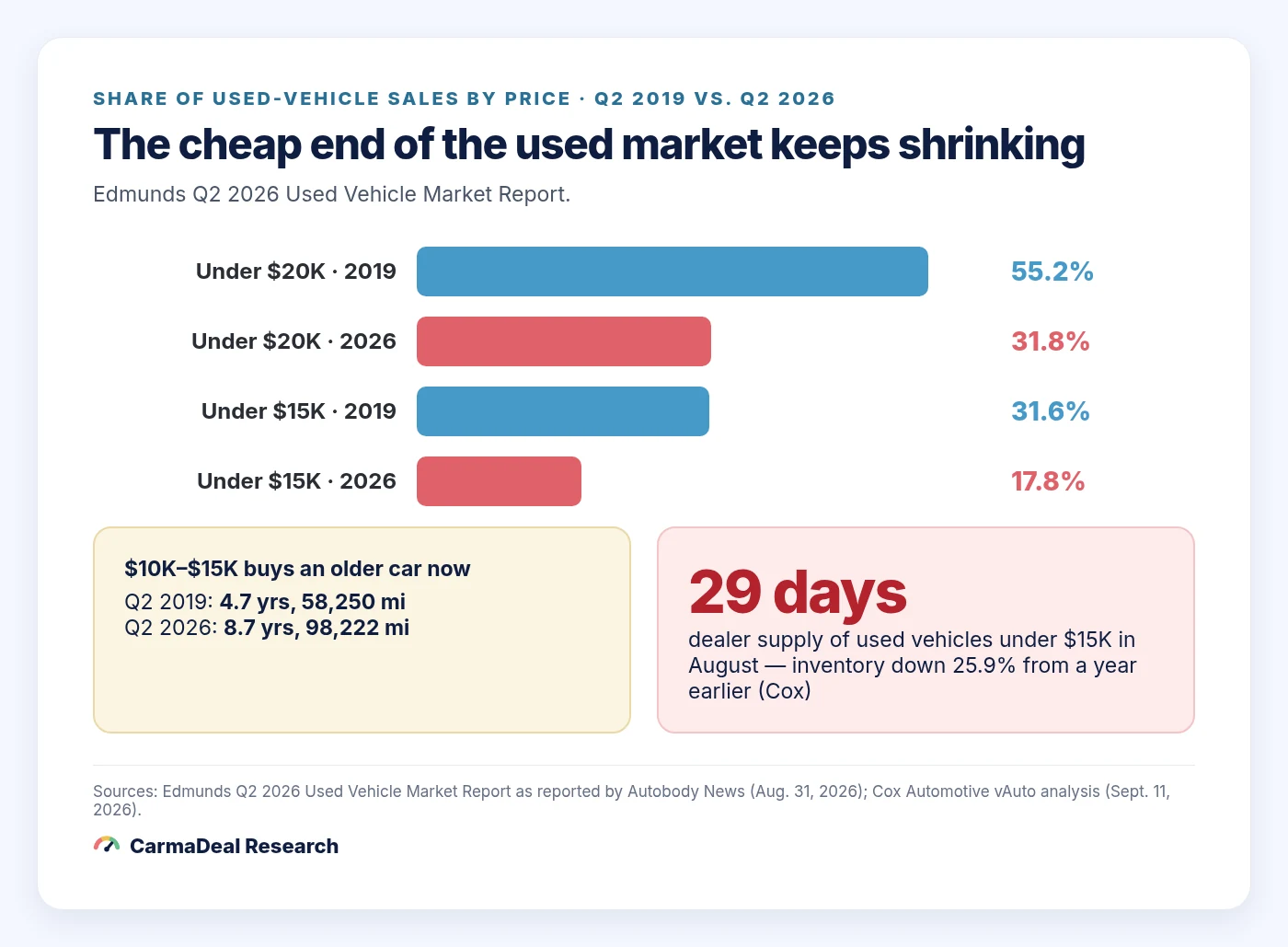
Edmunds' Ivan Drury summed it up: the same budget "now buys a vehicle that's four years older." Cox described vehicles under $20K as "the holy grail in the used market right now" in its Q3 presentation, adding that they are "getting increasingly scarcer." Cox also noted that 9- and 10-year-old vehicles were holding about six points above their long-term value averages in late August, because budget buyers keep showing up for the cheapest inventory.
02What this means when you shop
- Good cars sell fast. With about a month of supply, a well-priced $12,000 sedan may not last the weekend. Have your financing, insurance quote, and inspection plan ready before you start contacting sellers.
- Not much room to negotiate. Unlike SUVs and trucks, budget cars aren't getting much cheaper. Your leverage comes from problems you find, not from market softness.
- Condition matters more than the model. At 8–10 years and 100,000 miles, how a car was maintained can matter more than its brand's reliability reputation.
03Where to look
- Private sellers. Dealer inventory under $15K is thin, but private listings can fill the gap. You give up dealer recourse in exchange for price and often better maintenance records. Our private seller vs. dealership guide covers the trade-offs, and our payment-scam guide covers how to pay safely.
- Less popular, practical models. Well-known compact models often carry a premium. A less-hyped sedan or wagon with good service records can be a better buy at the same price.
- A slightly bigger radius. A two-hour drive can be worth it if it gets you a cleaner car, especially out of the salt belt or flood-prone areas.
- A slightly higher budget. In Edmunds' Q2 data, the average car sold for $15K–$20K was about 6 years old with about 71,000 miles, compared with 8.7 years and 98,000 miles in the $10K–$15K range. Weigh that against a bigger loan, and see our reliable used cars under $20K list.
Whichever route you take, line up several candidates at once. With so few cars in this range, having a backup or two keeps you from overpaying for the first one you find.
04Risks at 100,000 miles
Older, higher-mileage cars are where history and maintenance problems tend to show up. Check these before you hand over money:
- Title and history. Salvage, rebuilt, and flood brands, odometer inconsistencies, and gaps in ownership. Use our History Report Analyzer and read why a clean report isn't always clean.
- Timing belt and other big service items. At this age they're often due. Ask for receipts. Our timing chain vs. belt guide explains the walk-away rules.
- Tires, brakes, and suspension. These can easily add $1,000–$2,000 right after purchase. Check tire age with our DOT code guide.
- Open recalls. Older cars often have recalls that were never fixed. Recall repairs are usually free at a franchise dealer, but federal law doesn't require a free fix on cars that were already more than 15 years old when the recall was issued. Check the VIN at NHTSA's recall lookup and confirm with a dealer that the repair is covered before you buy.
An independent pre-purchase inspection typically costs much less than one major repair. Repair prices are still rising (the BLS maintenance-and-repair index was up 5.2% year over year in August), so an inspection is worth it on any car at this age.
05Check the car before you get attached
When good cheap cars are scarce, it's easy to fall for the first decent one you see. Before you do, enter its 17-character VIN on CarmaDeal. You'll see a Deal Score against live local comparables, so you know whether $13,500 is fair for that exact car. Then check title and accident history in our History Report Analyzer before you schedule an inspection. Add the advertised price to get an itemized out-the-door estimate for your ZIP.
Sources and verification notes
- Cox Automotive, Used-Vehicle Prices Reach Highest Level Since 2022 as Inventory Tightens in August, Sept. 11, 2026.
- Edmunds Q2 2026 Used Vehicle Market Report, as reported by Autobody News (Aug. 31, 2026). The original Edmunds report could not be fetched directly during research; figures are as reported by Autobody News.
- Cox Automotive, Q3 2026 MUVVI presentation transcript (under-$20K quote; 9–10-year-old value retention).
- BLS, CPI maintenance and repair (Aug. 2026 vs. Aug. 2025, computed by CarmaDeal).