For most of the past five years, buying a used pickup or SUV meant paying close to whatever the dealer asked. That's starting to change. Cox Automotive's latest wholesale data shows the vehicles that dominate American driveways losing value faster than usual this fall. Higher fuel prices, rising interest rates, and more off-lease and rental supply are all behind it. Dealer sticker prices usually lag auction prices. That lag is your opening.
- In September, Manheim wholesale values were down 3.4% for SUVs and 2.3% for pickups year over year. Three-year-old vehicles fell about 6% during Q3, about twice the usual drop.
- Off-lease supply is rising (≈190K a month in the first half to ≈220K in the second half), and lease equity has turned negative, so more of those vehicles are going to auction.
- You can use this if you compare against local comparables, focus on vehicles that have sat on the lot, and keep the talk on price, not payment.
01What changed in the third quarter
Cox's September Manheim Used Vehicle Value Index came in at 205.9, down 0.6% from a year earlier and 1.1% from August. A typical September rises 0.3%. Cox chief economist Jeremy Robb said that "as September closed, depreciation was steeper than we typically see this time of year," pointing to the Middle East conflict, record diesel prices, and "interest rates climbing rapidly."
The big body styles took most of it. In Cox's Q3 presentation, SUVs were down 3.4% year over year, sedans 3.3%, and pickups 2.3%. At midyear, the overall index had been up 2.1%. Cox named three causes: SUVs and pickups are the hardest units to finance as rates rise, rental and off-lease returns are adding younger SUVs to auctions, and bigger vehicles take the biggest hit from expensive fuel.
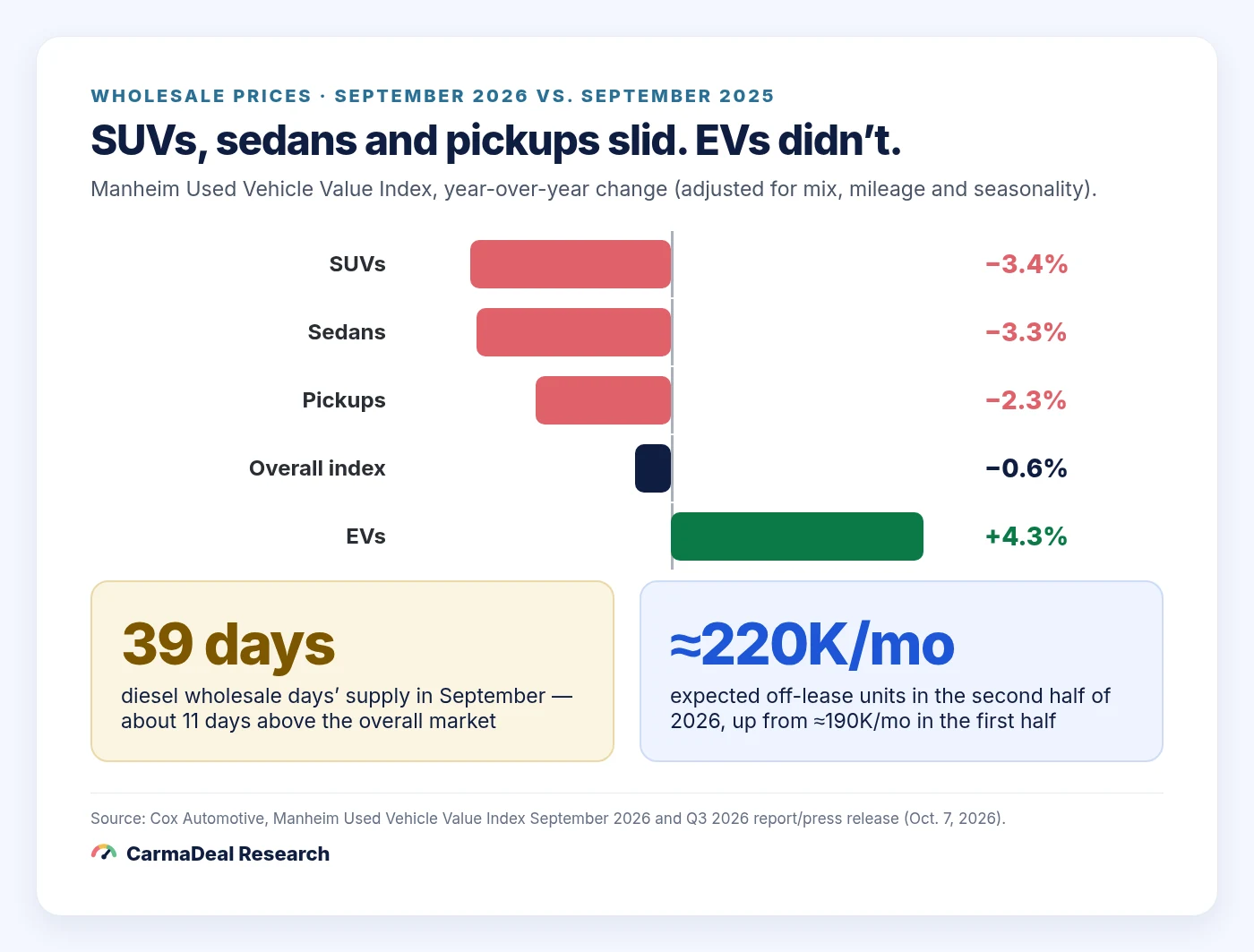
Diesel stands out. Diesel vehicles are only about 3% of Manheim's wholesale units, but with diesel near $6.50 a gallon, their days' supply rose to 39 in September, 27% higher than a year earlier and about 11 days above the overall market, according to the Q3 press release.
02More supply is coming
Cox expects off-lease supply to rise from about 190,000 units a month in the first half of 2026 to about 220,000 a month in the second half. Its lease-equity measure, which compares a vehicle's wholesale value with the residual in its lease, peaked near +$1,300 in March and fell to about −$1,700 by September. When equity is negative, lessees and dealers are less likely to buy the vehicle out, so more of them go back through auction. Cox also says rental check-ins were up about a third from a year ago, and that SUVs made up more than half of the rental units it sold last quarter.
For buyers, that means more two- to four-year-old SUVs and trucks competing for the same shoppers heading into what Cox calls "usually the weakest stretch of the year for wholesale values." If you're thinking about a lease-end car, our lease buyout guide explains why negative equity often means you should walk away from the buyout.
03Wholesale isn't retail, yet
The Manheim index tracks what dealers pay at auction, not what you see on a windshield. Retail prices usually follow with a lag, and in August they were still rising. Cox's retail analysis put the average used listing price at $27,239, 7% above a year earlier. A dealer who stocked a truck in June may still be pricing it based on June's wholesale market.
That gap is where you have leverage. Cox reported retail used days' supply climbing to about 49 days by late September, up from 44 in August. More cars sitting means more dealers who need to turn inventory.
04How to negotiate in a softening segment
- Compare the exact configuration. A 4x4 crew cab and a 2WD regular cab are different markets. Line up three to five comparable listings by year, trim, drivetrain, bed and cab, engine, and mileage band.
- Look for stale listings. A truck that hasn't had a price cut in five or six weeks while comparable trucks dropped is a good target. Our inventory-age guide explains why age helps only when the price is still above the fair range.
- Use the market, not the headline. "Wholesale is down 3%" won't move a sales manager. "Two comparable trucks within 30 miles are listed $1,800 lower, and this one has been listed for seven weeks" might.
- Negotiate the out-the-door price. Falling vehicle values don't help you if the savings come back as add-ons or a longer loan. Rates are rising too. Lock in your financing first (see our guide to getting a used-car loan after the Fed's hike).
- Think about resale. If you'll trade again in two or three years, a vehicle that's depreciating quickly now may keep doing it. Buying low helps on both ends.
05Who should wait, and who shouldn't
If you need a truck or a large SUV and can wait a few weeks, the trend is in your favor. Cox lowered its year-end forecast and now expects the index to finish 2026 up only about 0.2%, compared with the 2% it forecast in July. If you're shopping for something small and efficient, don't expect the same discount. Compact cars and EVs held up.
Whatever you decide, judge the specific vehicle, not the national average. Enter the 17-character VIN on CarmaDeal to see where the asking price sits against live local comparables, get a Deal Score, and see an out-the-door estimate when you add the advertised price.
Sources and verification notes
- Cox Automotive, Manheim Used Vehicle Value Index: September 2026 Trends, Oct. 7, 2026 (index level, Robb quote).
- Cox Automotive, Q3 2026 MUVVI press release (diesel days' supply, off-lease volumes, year-end forecast).
- Cox Automotive, Q3 2026 MUVVI presentation transcript (body-style changes, lease equity, rental check-ins, 3-year-old index, retail days' supply).
- Cox Automotive, Used-Vehicle Inventory, August 2026, Sept. 11, 2026.
- The negotiation script uses illustrative numbers. Wholesale indexes don't predict the price of any single vehicle.